
Explain that Election
All Australians should feel empowered to engage in our democratic processes. A lack of knowledge about these processes, and the ways in which people can get involved, is one roadblock that may deter otherwise interested citizens from participation.
One of our goals at Democracy Developers is to develop tools that foster democratic participation. Our latest project—Explain that Election—aims to provide tools that explain what government looks in Australia, how law-making works, what kinds of elections we have, and how our votes are counted.
A core focus of Explain that Election is to help people understand how votes are counted in the different kinds of elections that take place in Australia. Australia is a pioneer of preferential voting, where we rank candidates in order of preference. For some of our elections—e.g., for our Senate in the Federal Parliament—the process used to count our votes and determine winners is very complex. We aim to shine a light on these processes with visualisations that take voters through these counts step-by-step.
As a proof of concept, and to guide us in developing the applications in this project, we have developed a prototypical version of Explain that Election, available at https://explain-that-election.vercel.app.
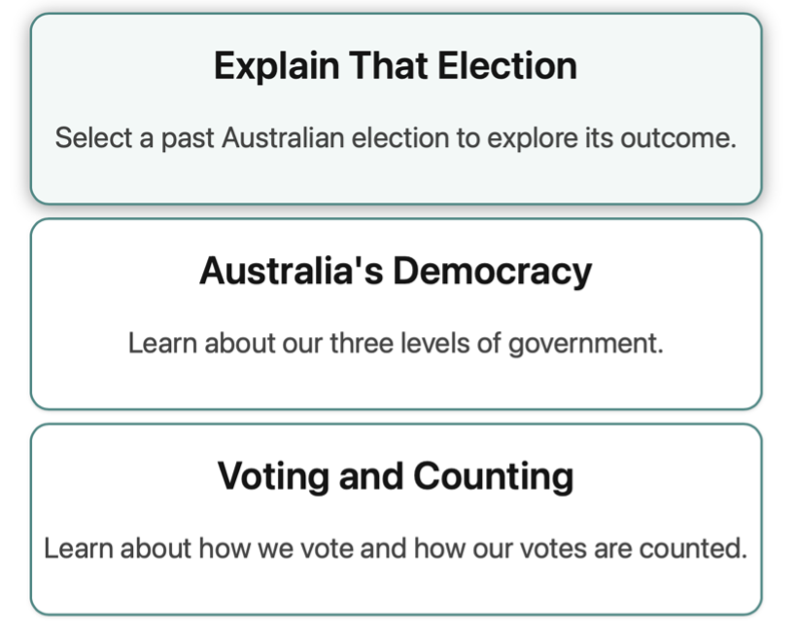
The landing page of the Explain that Election prototype gives visitors three options to explore: Explain that Election; Australia’s Democracy; and Voting and Counting.
Explain that Election
This section of the prototype allows a visitor to select a level of government (currently only the federal level is available), a chamber of parliament, and an election year. For our federal level of government, visitors can select to explore elections for our House of Representatives or our Senate.
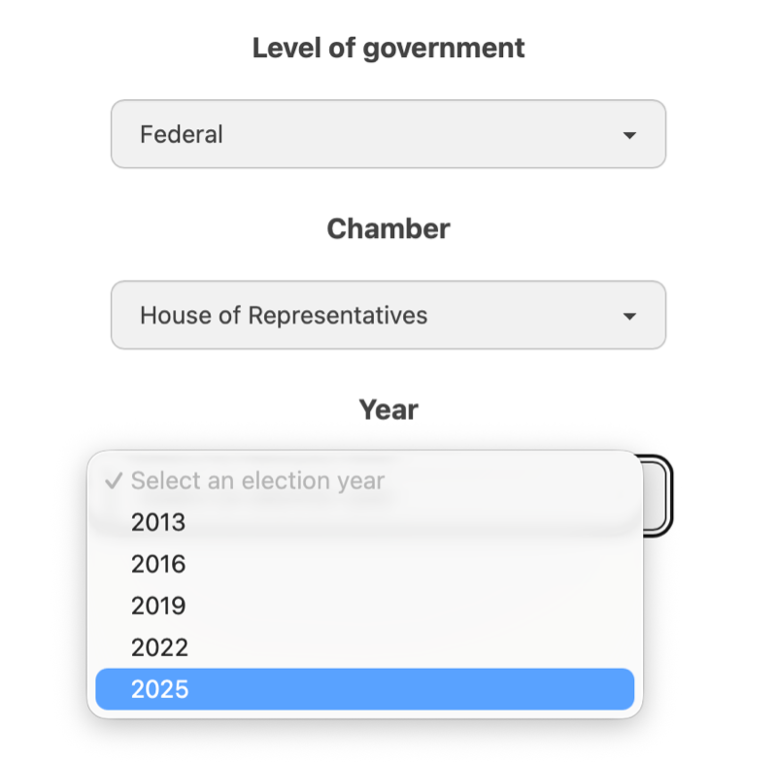
When exploring House elections, we display a summary of the outcome of the selected year’s election and allow the visitor to choose an electorate to explore in detail.
Let’s look at the 2025 election for our House of Representatives.
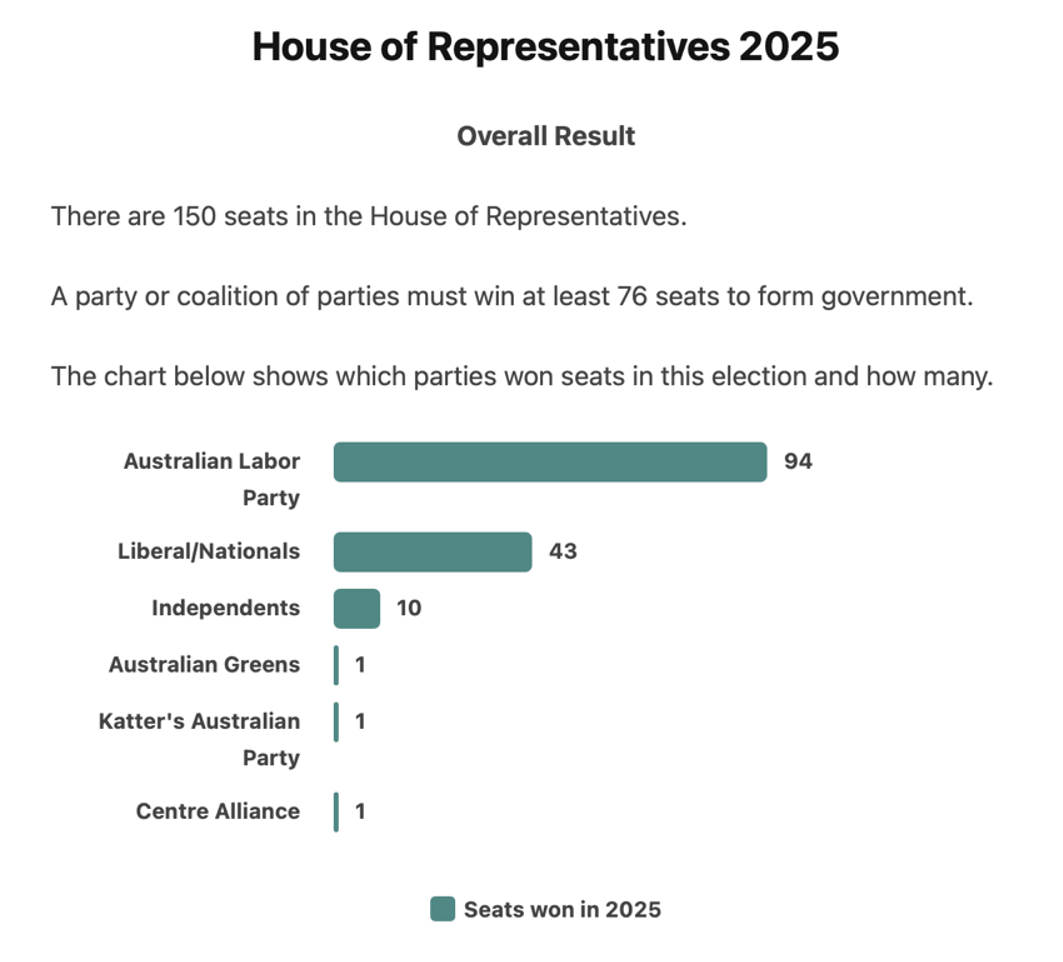
A party or coalition of parties needs to win at least 76 of the 150 seats in our House of Representatives to form government. This election was won by the Australian Labor Party, who won 94 seats. Let’s look at the electorate of Canberra in the Australian Capital Territory. When a visitor selects this electorate to explore, they will see the following display.
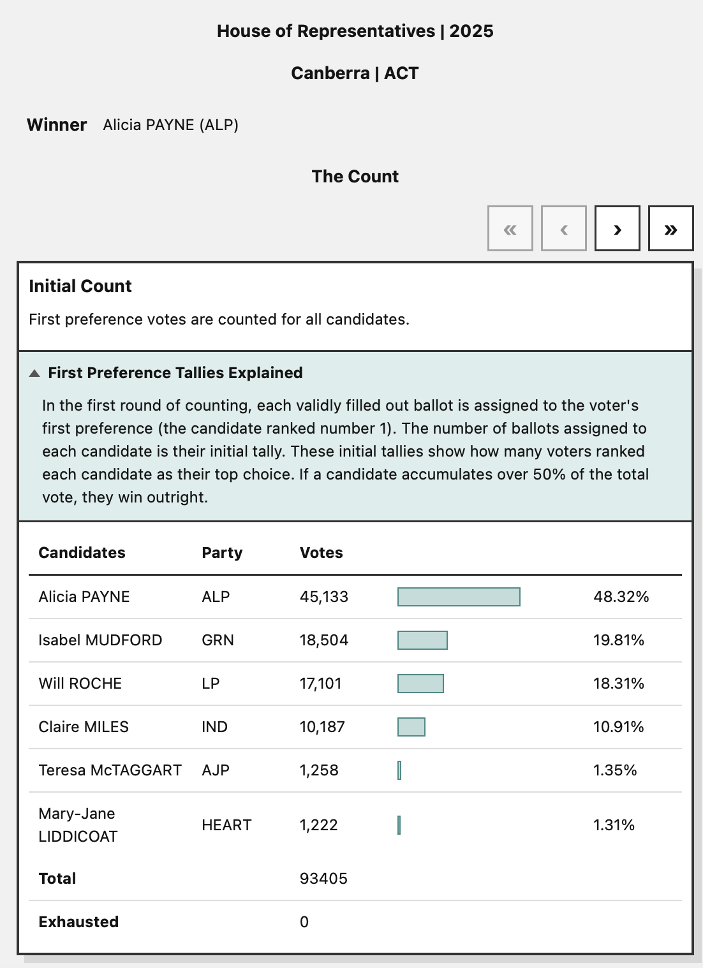
Alicia Payne of the Australian Labor Party won this seat. We can step through the count to see how this happened. In the first step, we show how many first preference votes each candidate received. These are the number of votes which rank each candidate as number 1 (most-preferred). When moving to the next step, we see what happens next.
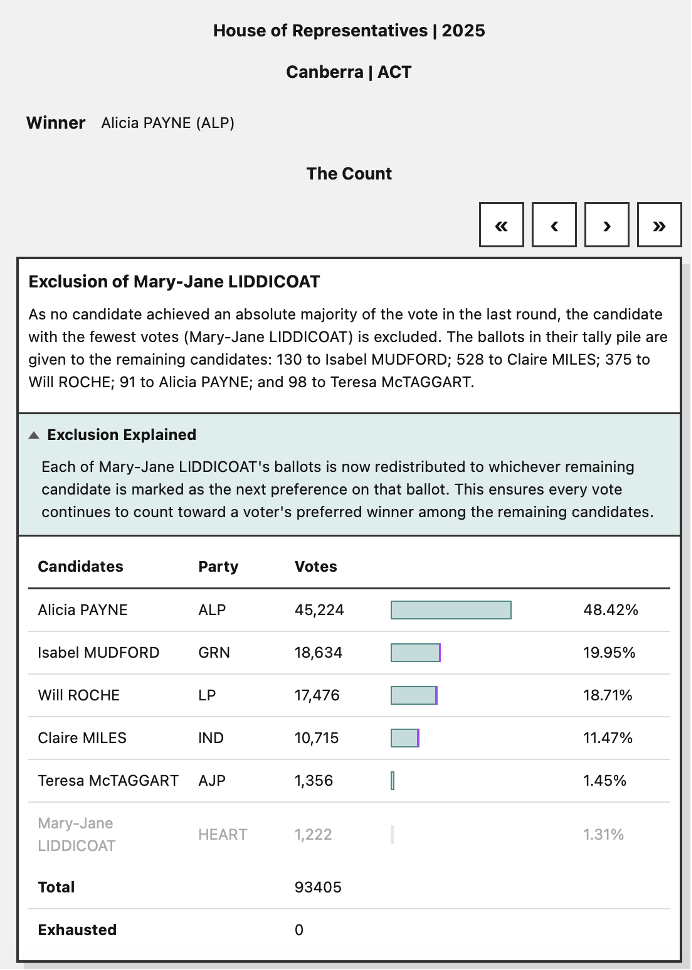
Mary-Jane Liddicoat had the smallest tally and is excluded from the contest. Her votes are passed on to their next-most preferred candidate. We can see that the tallies of each candidate have increased. Let’s move to the next step.
Claire Miles now has the smallest tally and is excluded from the contest. Her votes are passed on to the next-most preferred candidate among those who are still in the contest. We can see below how the tallies of these candidates have increased.
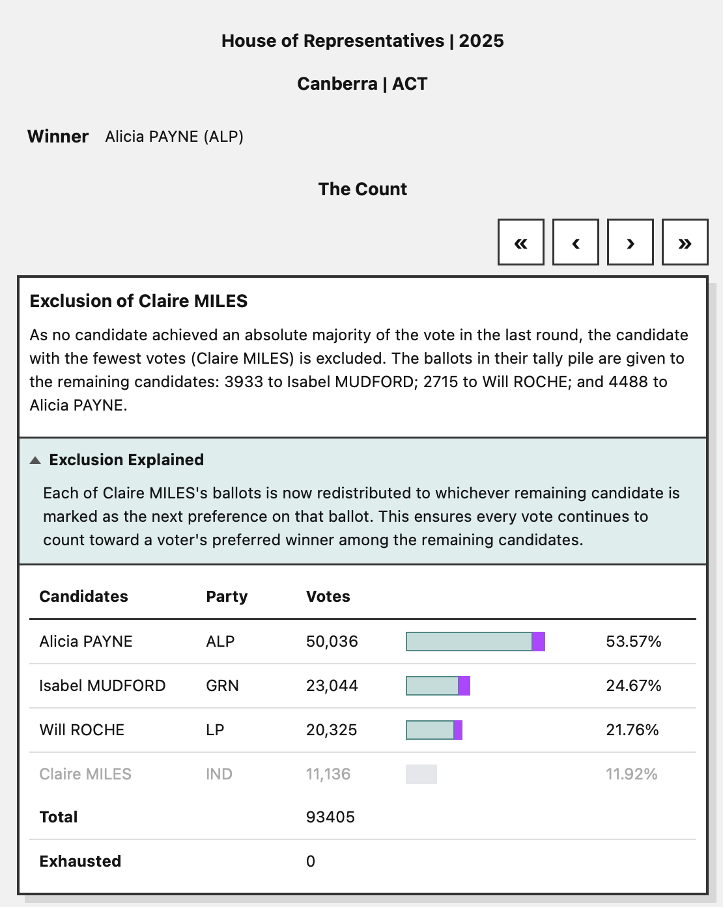
We can see now that Alicia Payne of the ALP has a majority of the vote. This means that she is going to be the winner. The full distribution of preferences continues, however, with Will Roche being the next excluded candidate.
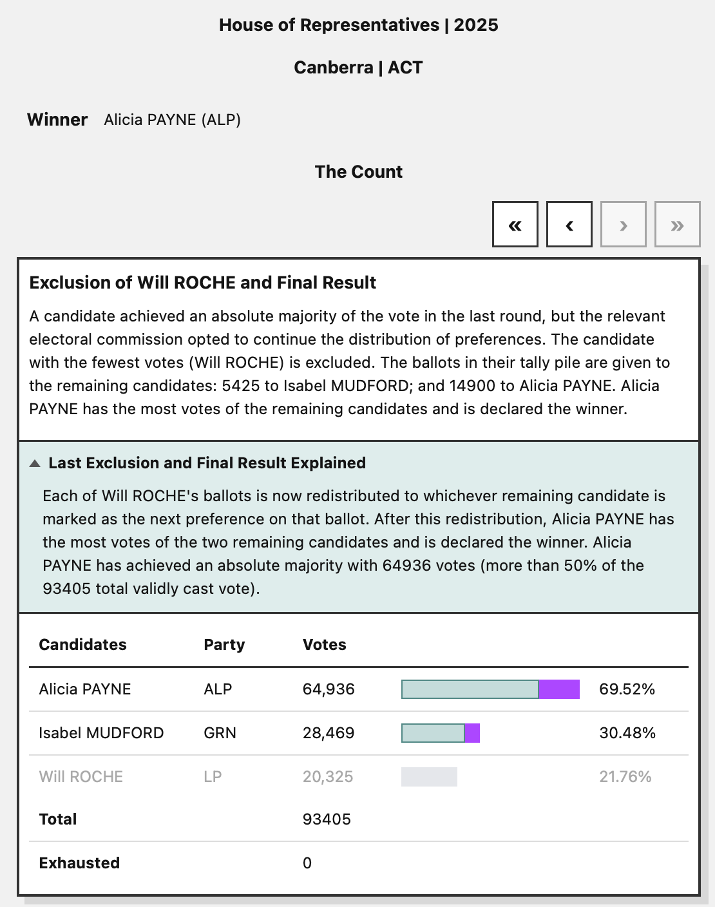
In our prototype, visitors can see this kind of step-by-step visualisation of the count for each seat of our House of Representatives for the federal elections that have occurred since 2016. Senate count visualisations are also available for the 2019, 2022, and 2025 federal elections.
Australia’s Democracy
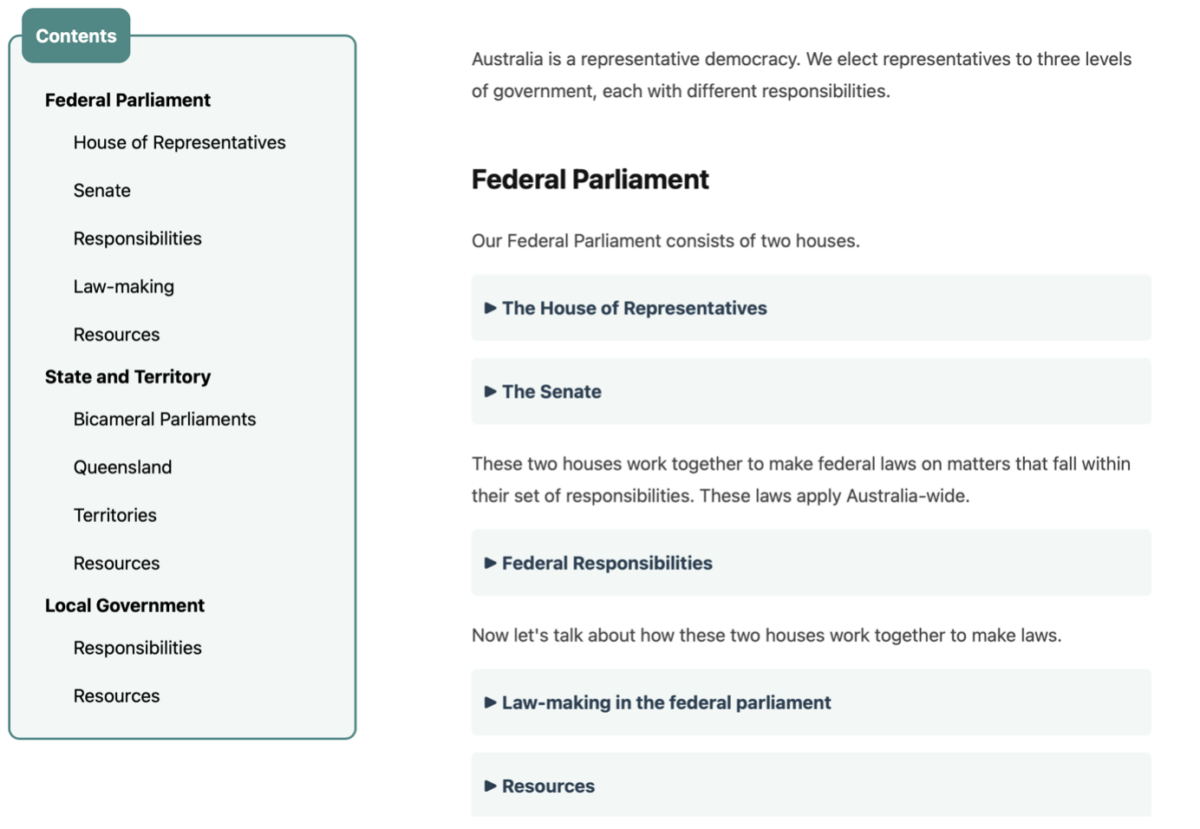
In this part of the prototype, visitors can learn more about our levels of government—Federal, State and Territory, and Local—and our law-making processes. For each level of government, we talk about the structure of the parliament or governing bodies, their responsibilities, and how they pass laws. Resources to existing educational materials, and those developed by our Parliamentary Education Office in particular, are provided to give visitors access to more information.
Voting and Counting
Visitors can explore in-depth explanations of how we vote in our elections, and how we work out who wins. We cover preferential voting in single-winner elections (e.g., each electorate in our House of Representatives) and preferential-proportional voting in multiple-winner elections (e.g., each state and territory in our Senate).
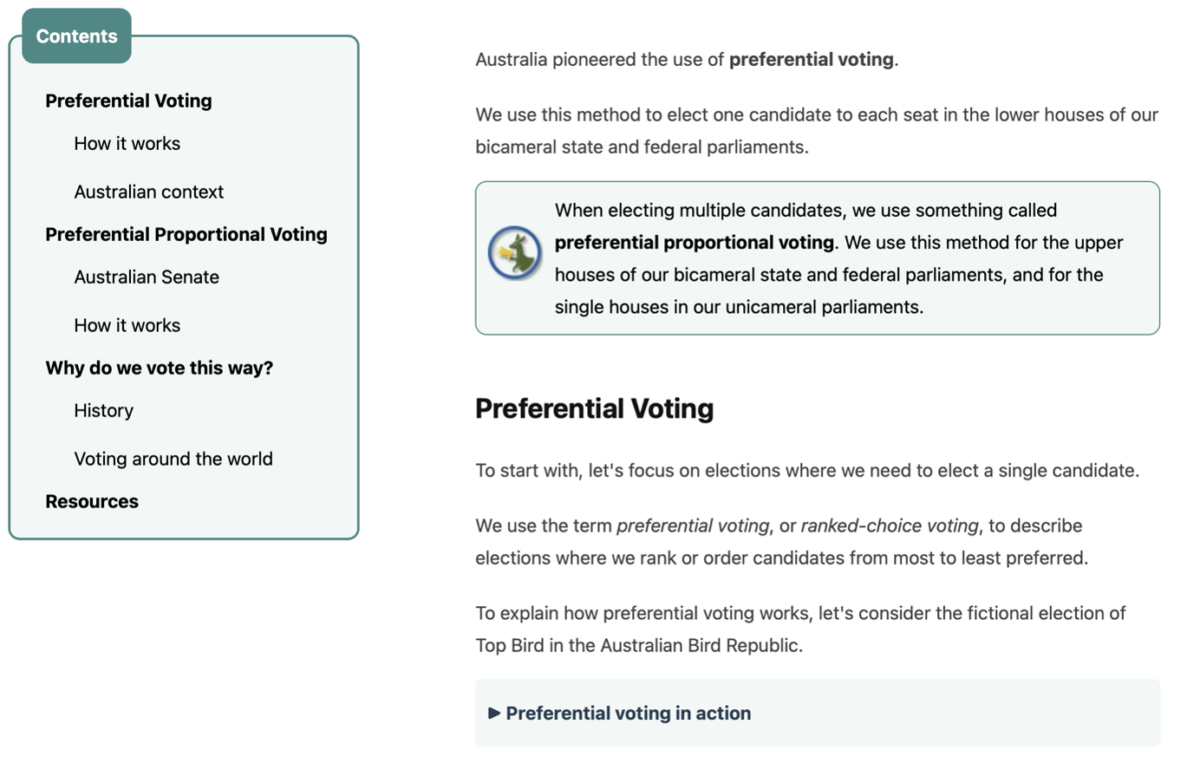
Our prototype explores preferential and preferential-proportional elections through the lens of a fictional republic of Australian birds.
In our example, a Tawny Frogmouth, Kookaburra, Emu, and Magpie are vying for the role of Top Bird. After the citizens cast their ballots, first preferences were counted.
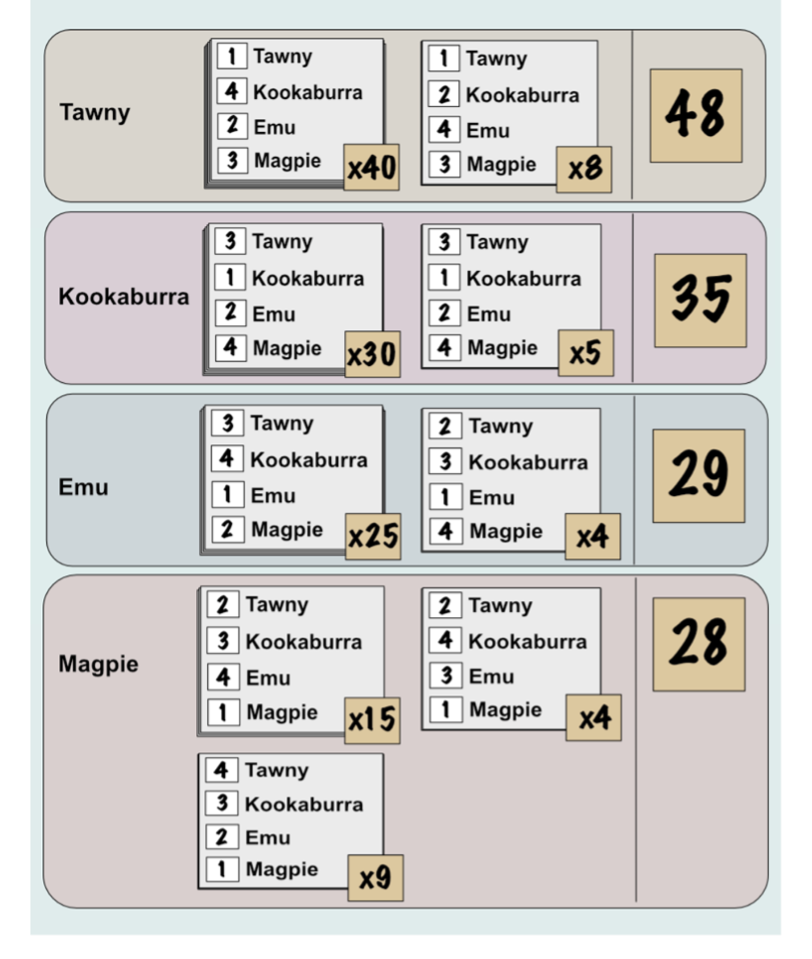
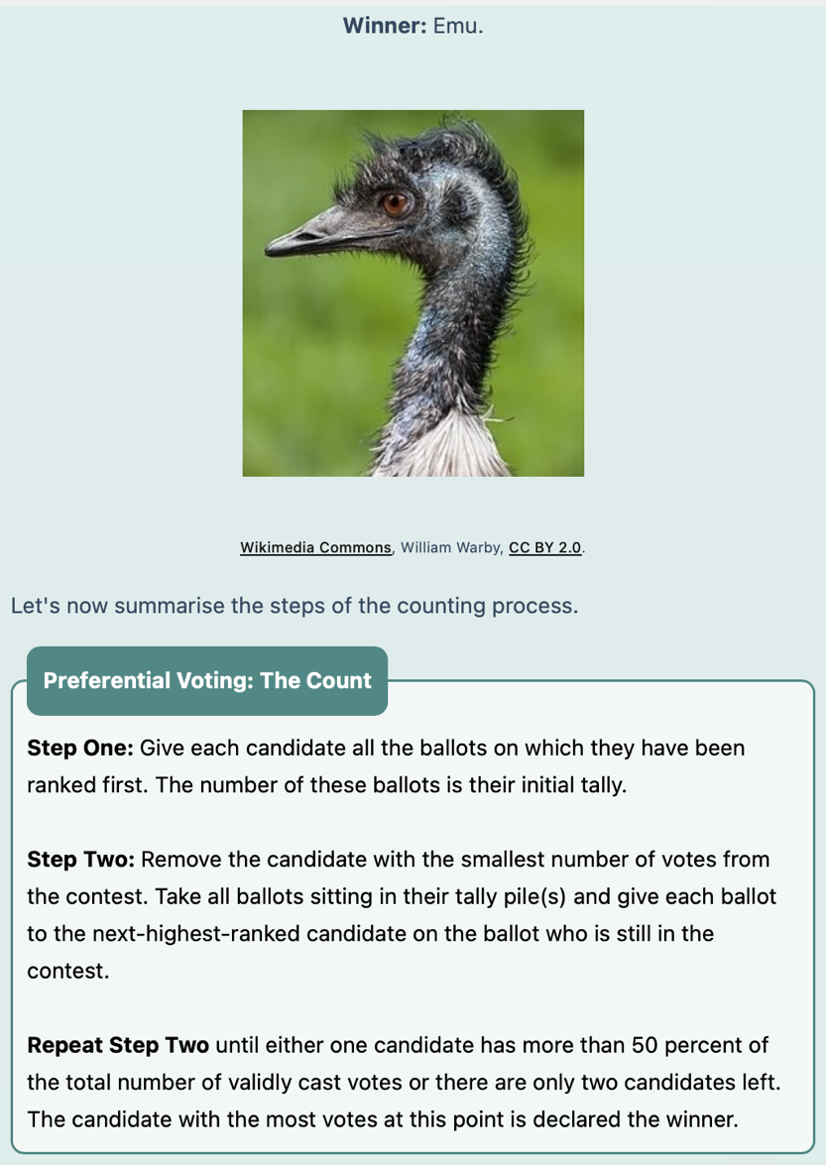
The Tawny Frogmouth was ahead in the first round of counting. After following each step of the count, we see that the Emu is our Top Bird winner.
Textual description of image
This image shows the Emu winning the Top Bird contest followed by a summary of the overall counting process. This summary is written in text below.
Step One: Give each candidate all the ballots on which they have been ranked first. The number of these ballots is their initial tally.
Step Two: Remove the candidate with the smallest number of votes from the contest. Take all ballots sitting in their tally pile(s) and give each ballot to the next-highest-ranked candidate on the ballot who is still in the contest.
Repeat Step Two until either one candidate has more than 50 percent of the total number of validly cast votes or there are only two candidates left. The candidate with the most votes at this point is declared the winner.
The principle guiding us in the development of Explain that Election is that people who are interested in learning more about these topics—the levels of Australian government, elections and vote counting, and how the counts proceeded in past elections—should be able to easily access trustworthy information.
Next steps
Feedback on any of the content presented in the Explain that Election prototype is welcome, and can be passed on to the Democracy Developers team by emailing info@democracydevelopers.org.au. This feedback will help us design and build a series of applications for explaining Australian elections and fostering greater engagement in our democratic processes.